
Automatic scanners are useful, but they don't tell the whole security picture. They may find some of the technical errors, but often miss the most dangerous ones: problems in business logic, improper authorization, role bypass, API vulnerabilities, and scenarios that require human analysis.
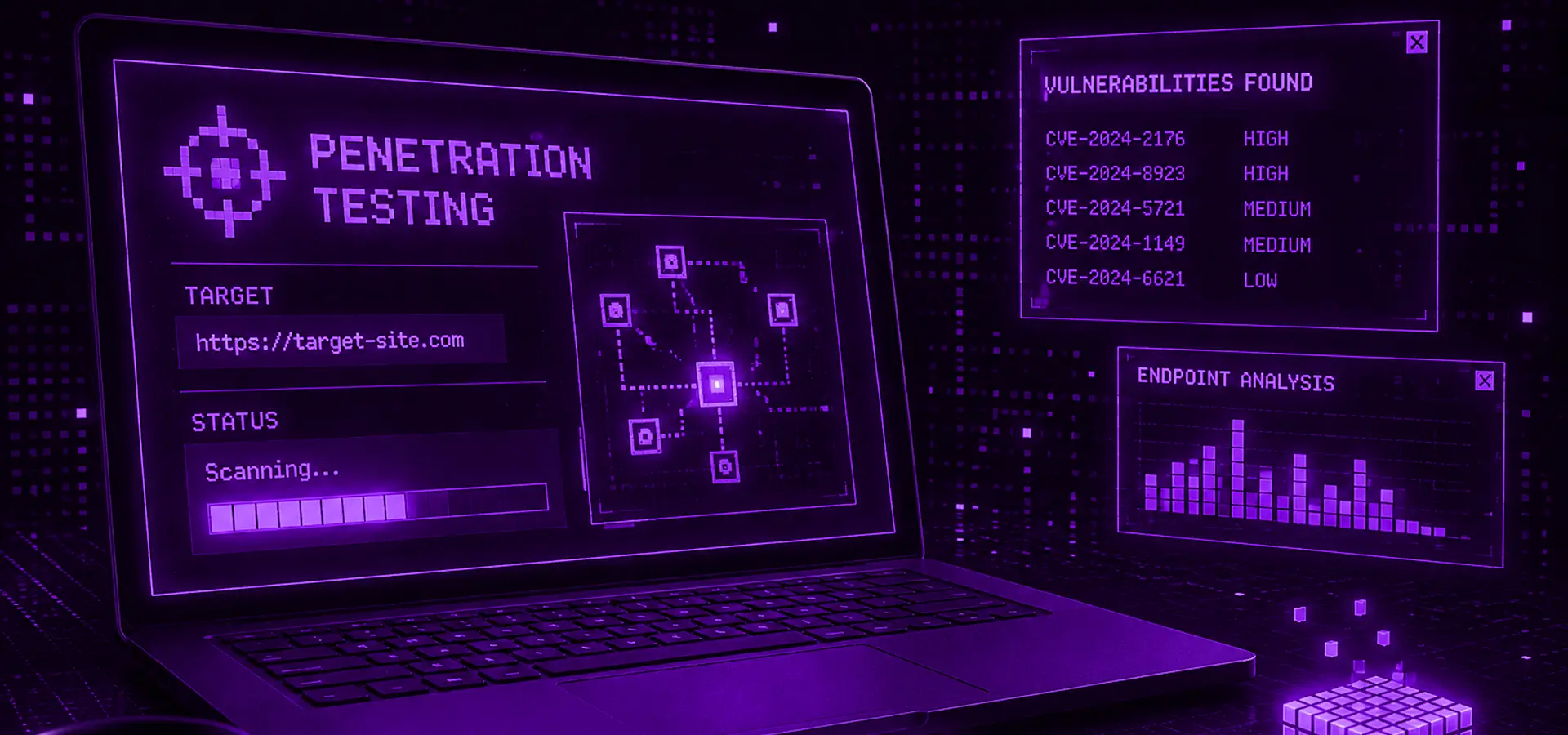
Penetration testing is a controlled examination of a system through the eyes of an attacker. Its purpose is not just to find "errors", but to show how these errors can affect the business.
What is penetration testing?
Penetration testing is a safe and controlled simulation of an attacker's actions. A specialist checks a web application, API or infrastructure for vulnerabilities that can be used to access data, accounts, administrative functions or internal systems.
Unlike the usual check "by the list", pentest takes into account the logic of the product's operation: user roles, payment scenarios, personal accounts, integrations, access tokens and system behavior in non-standard situations.
How does pentest differ from automatic scanning
The automatic scanner works according to templates. It looks for known types of vulnerabilities: open services, outdated versions, basic configuration errors, part of problems in web applications.
Pentest works differently. A specialist analyzes the system manually, tests hypotheses, combines several weak points and assesses the real impact on the business.
A simple example
The scanner can show that the login form works without any obvious errors.
And pentest can detect that a user with the "manager" role can change the ID in the request and access the data of another client.
For businesses, this is no longer a technical trifle, but a risk of data leakage.
What scanners usually miss
More often than not, automated tools don't see problems that depend on the context.
Typical examples
- the user sees someone else's orders or documents;
- role restrictions can be bypassed;
- The API allows you to perform an action without the necessary rights;
- the payment scenario can be changed manually;
- the system incorrectly checks the user's status;
- access tokens work longer than necessary;
- hidden endpoints remain available;
- changing the parameter in the request opens access to someone else's data.
Such problems often do not look like a classic "vulnerability", but they can create the greatest risks for the company.
Why does an API need separate validation?
Modern products often work through APIs: mobile applications, personal accounts, CRM, payment systems, integrations with partners. An API may be technically hidden from the average user, but accessible to an attacker. If the API does not properly implement authorization, role validation, or request restrictions, it can lead to data leakage or mass abuse of the system.
What is checked in the API
- authentication;
- authorization at the object level;
- authorization at the function level;
- access tokens;
- rate limiting;
- error handling;
- leakage of technical information;
- business logic of requests.
For SaaS, FinTech, e-commerce and enterprise platforms, API security testing should be a separate mandatory stage.
What risks does penetration testing show?
A good pentest answers not only the question "what is broken?", but also the question "what does it mean for the business?".
It shows:
- whether it is possible to access someone else's data;
- is it possible to bypass authorization;
- can the user's role be promoted;
- whether it is possible to influence financial transactions;
- is it possible to get access to the administrative part;
- whether the API can be used for bulk data collection;
- whether user accounts can be compromised;
- which vulnerabilities should be patched first.
This is what distinguishes a pentest from a technical scan: the result is linked to real consequences.
What should be in the report after testing
The report after penetration testing should be useful not only for the technical team, but also for the management.
A qualitative report includes:
- short resume for business;
- list of vulnerabilities found;
- level of criticality;
- description of potential impact;
- playback steps;
- evidence of vulnerability;
- correction recommendations;
- priority of works;
- status after recheck.
Without clear recommendations, the report turns into a list of problems. A correct pentest result is an action plan.
When a business needs a pentest
Penetration testing should not only be done after an incident. The best time is before the problem becomes real.
Pentest requires:
- before launching a new product;
- after major changes in the system;
- before audit or certification;
- after integration of payment services;
- after changing the authorization logic;
- for SaaS, e-commerce, FinTech and personal accounts;
- if the system processes personal or financial data;
- if there has been no independent verification for a long time.
Regular testing allows you to find risks before attackers take advantage of them.
Conclusion
An automated scanner is a useful tool, but it is not a substitute for thorough penetration testing. The scanner sees standard technical problems, while the pentest shows real attack scenarios and their business impact.
If a company works with personal data, financial transactions, APIs or complex access logic, manual testing is a critical stage of protection.