
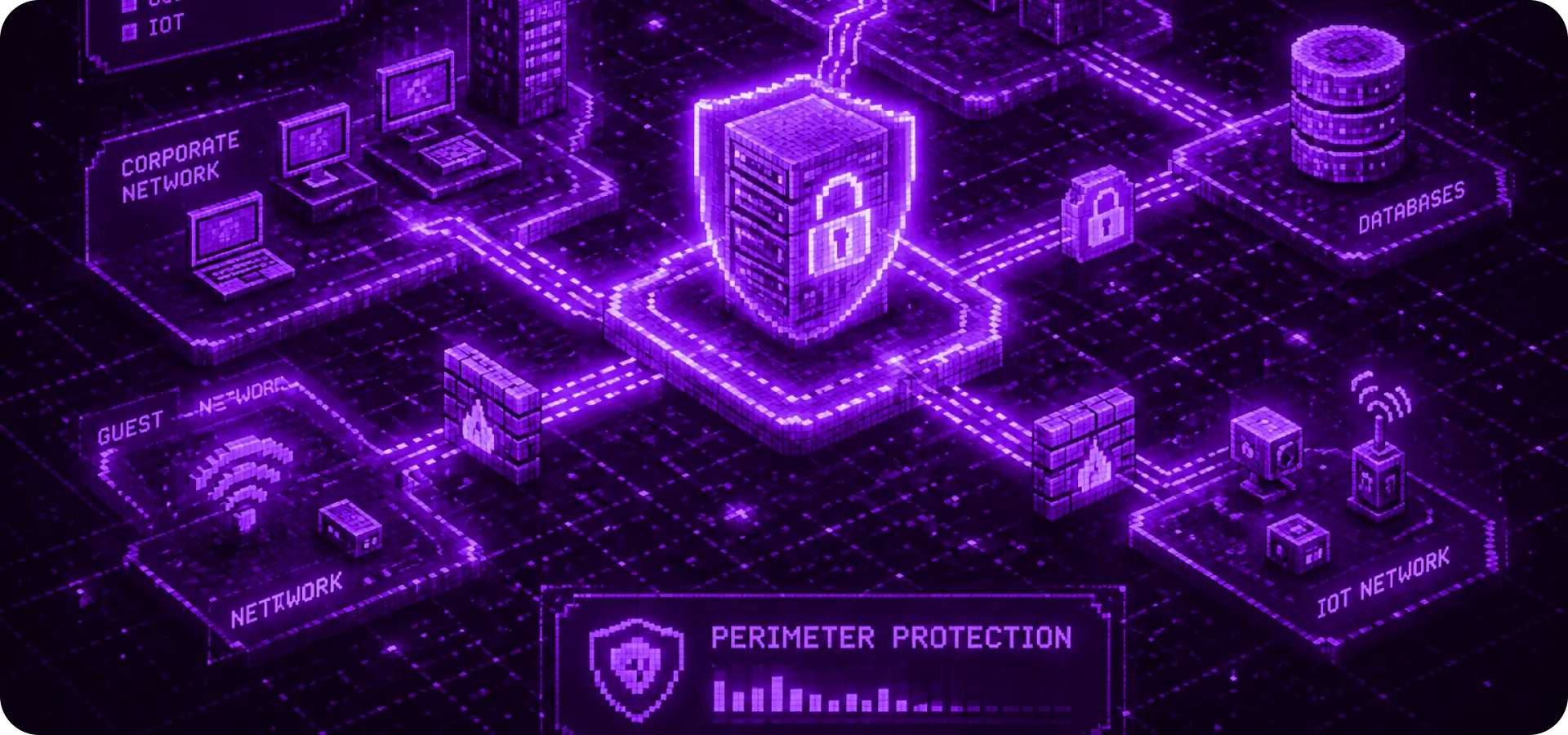
Network infrastructure is the backbone of business. Employee accesses, corporate mail, servers, databases, cloud services, Wi-Fi, VPN and internal systems pass through it.
If the network is built chaotically, without segmentation, access control and redundancy, any incident can quickly spread throughout the company. That is why a protected network infrastructure should not be an additional option, but a basic element of business security.
What is a secure network infrastructure?
A secure network infrastructure is a system in which each element has a clear role, controlled access, and clear rules of engagement.
It includes:
- routers;
- switches;
- firewall;
- servers;
- Wi-Fi;
- VPN;
- cloud services;
- backup;
- monitoring;
- access rules.
The main goal is not just "to make everything work", but to keep the system stable, controllable and resistant to attacks.
Why a "flat" network is dangerous
One of the most common problems is when all devices are on the same network: employees, servers, guest Wi-Fi, printers, databases and management systems.
This is called a "flat" network. Its main risk is that after compromising one device, the attacker can move further inside the infrastructure.
For example, an infected employee's laptop can become an entry point to servers, file storage, or internal systems.
Network segmentation
Segmentation is the division of the network into separate zones with different levels of access.
For example:
- user network;
- server area;
- guest Wi-Fi;
- control area;
- database;
- production network;
- DMZ for public services.
Segmentation reduces the consequences of an incident. If one segment is compromised, the attack should not automatically spread to the entire infrastructure.
Perimeter and firewall protection
Firewall is one of the key elements of network protection. But just installing a firewall is not enough. It is important to correctly configure access rules, limit unnecessary services and control traffic.
What to check:
- which ports are open to the outside;
- who has access to internal systems;
- are there separate rules for departments;
- whether suspicious connections are recorded;
- whether brute-force protection is used;
- whether basic DDoS protection mechanisms are in place.
A well-configured firewall reduces the attack surface and helps control access to critical resources.
VPN and secure remote access
Remote work has become the norm for many companies. But if access to internal systems is organized incorrectly, it creates a serious risk.
A secure VPN should include:
- two-factor authentication;
- role-based access restrictions;
- connection logging;
- device control;
- clear separation of accesses;
- regular review of users.
A VPN doesn't have to be the "one door to everything". An employee should only have access to those systems that he needs for work.
Backup and restore
A reliable infrastructure is not possible without backup. Backup is needed not only in case of a technical error, but also to protect against ransomware, human factors and hardware failures.
A proper backup system should follow the principle:
- multiple copies of data;
- different media or media;
- one copy outside the main infrastructure;
- protection against modification or deletion;
- regular recovery testing.
A backup that no one has checked cannot be considered reliable.
Monitoring and logging
Without monitoring, a company may not be aware of an incident until the consequences have already become critical.
Logging and monitoring allow you to see:
- suspicious logins;
- failed authorization attempts;
- changes in configurations;
- unusual network traffic;
- attempts to access critical systems;
- signs of brute-force or DDoS.
Monitoring does not guarantee complete security, but it significantly reduces the time it takes to detect a problem.
How to start a business
If the company does not have a clear picture of its infrastructure, it is worth starting with an audit.
Practical procedure:
- Inventory servers, networks and services.
- Check the firewall and open accesses.
- Evaluate network segmentation.
- See VPN and remote access.
- Check the backup.
- Configure logging and monitoring.
- Prepare a security enhancement plan.
Conclusion
Secure network infrastructure is not just hardware and settings. This is a systemic approach where every access, server, Wi-Fi, VPN and backup should be part of a single protection logic.
Companies that implement segmentation, control access, configure firewalls, check backups, and monitor network events significantly reduce the risk of attacks, downtime, and data loss.