
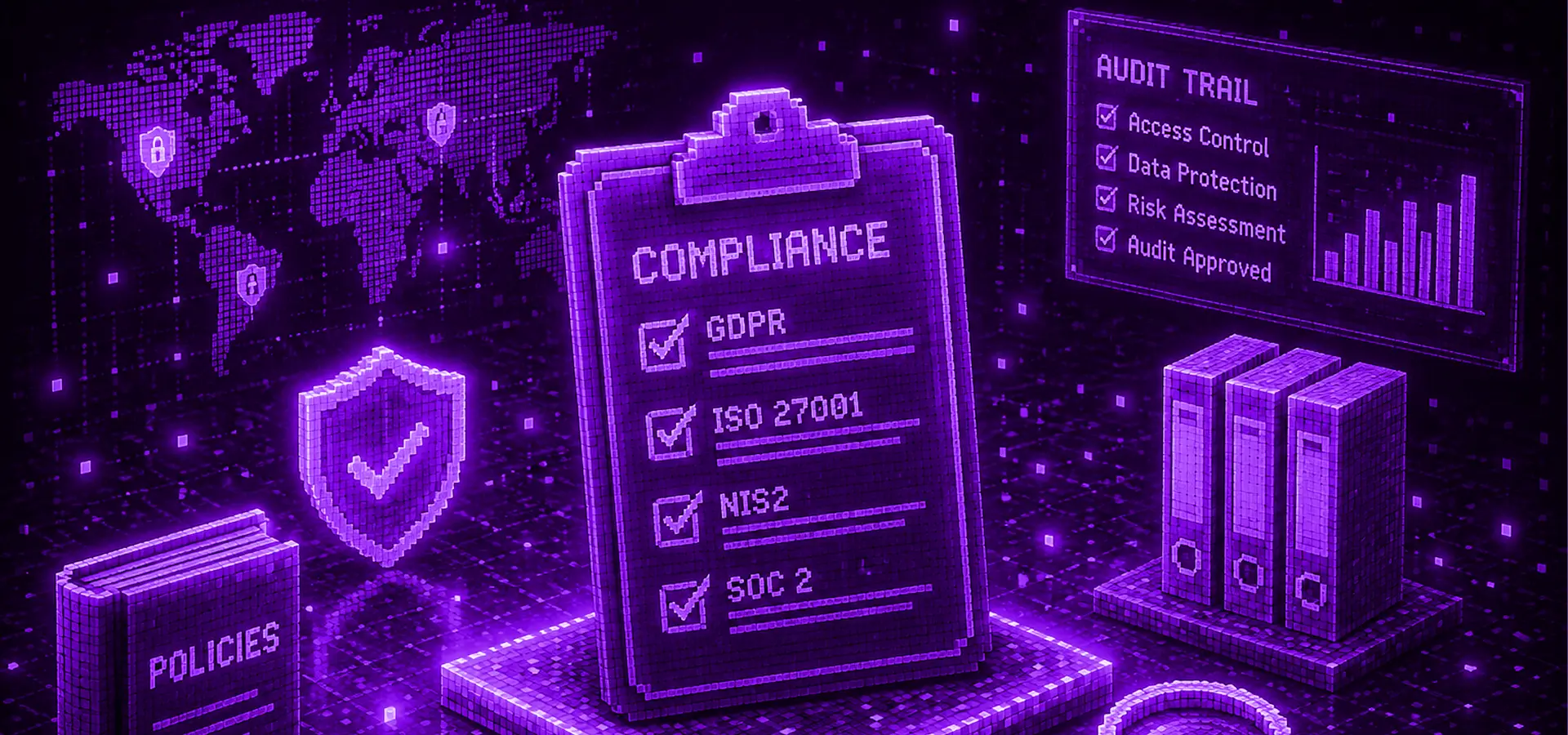
Compliance is not just documents for audit. For businesses, it is a way to show customers, partners and regulators that the company works responsibly with data, controls risks and has a clear security system.
GDPR, ISO 27001, NIS2 and other requirements may look complicated, but preparing for them starts with the basics: understanding what data you process, who has access to it, how it is protected and what happens in the event of an incident.
What is compliance in cybersecurity
Compliance in the field of cybersecurity is a company's compliance with legal, industry or contractual requirements for the protection of information.
Simply put, this is the answer to the question:
- what data the company stores;
- where they are stored;
- who has access to them;
- how the company protects this data;
- how user actions are recorded;
- what is done in case of an incident;
- can the company prove that the security works.
Compliance is important not only for large corporations. It is becoming critical for SaaS, FinTech, e-commerce, healthcare, IT teams and businesses that work with personal or financial data.
Why it is important for businesses to prepare for the requirements
Preparation for GDPR, ISO 27001 or other standards helps not only to "close the formalities". It reduces real business risks.
The company receives:
- transparency in working with data;
- access control;
- clear security policies;
- readiness for incidents;
- trust of clients and partners;
- arguments for enterprise sales;
- less risk of fines and reputational losses.
For many B2B companies, compliance with security requirements becomes a condition for cooperation with large customers.
GDPR: protection of personal data
GDPR applies to companies that process personal data of EU citizens or work with European customers.
What to check:
- what personal data is collected;
- for what purpose they are processed;
- where they are stored;
- who has access to this data;
- how the user can submit a request to delete or change data;
- whether there is a privacy policy;
- whether the data is technically protected;
- whether there is a spill response plan.
GDPR is not just a legal document. It is also the technical and organizational readiness of the company to protect data.
ISO 27001: information security management system
ISO 27001 is an international standard for building an information security management system.
Its main idea is that security should not be a random set of measures, but a systematic process.
The main elements of ISO 27001:
- risk assessment;
- information security policies;
- access management;
- asset control;
- incident response;
- backup;
- employee training;
- internal audit;
- continuous improvement.
Companies preparing for ISO 27001 must not just implement technical solutions, but build a managed security system.
NIS2: Resilience and Responsiveness Requirements
NIS2 strengthens the cyber resilience requirements of organizations operating in critical sectors or providing critical services.
For businesses, this means not only protecting yourself, but also having the ability to respond quickly to incidents.
NIS2 Focus:
- risk management;
- network and systems protection;
- business continuity;
- backup;
- incident response;
- supplier security;
- management responsibility.
Even if a company is not directly covered by NIS2, these principles are useful for building a mature cybersecurity system.
Where to start the preparation
The first step is to conduct an audit of the current state of security.
You need to understand:
- which systems are critical;
- what data is processed;
- what risks already exist;
- which policies are missing;
- which technical settings need strengthening;
- whether there are those responsible for security;
- whether processes are documented.
Without an audit, the company risks implementing chaotic solutions that do not cover real requirements.
What documents and processes are required
Preparation for compliance usually requires not only technical measures, but also documentation.
Basic set:
- information security policy;
- access policy;
- password and MFA policies;
- backup policy;
- incident response plan;
- register of assets;
- access matrix;
- change management procedure;
- removal or access restriction procedure;
- personal data processing policy.
Documents should reflect real processes and not exist separately from the company's work.
Typical mistakes of companies
Companies often make the same mistakes when preparing for standards.
The most common:
- start with documents, not with a real audit;
- copy policies that do not match the processes;
- do not control employee access;
- backups are not checked;
- do not have an incident response plan;
- do not log events;
- do not conduct team training;
- do not test web applications and APIs.
Compliance without real security creates only the illusion of protection.
How an audit helps to pass an inspection
A cybersecurity audit allows you to find the gap between the current state of the company and the requirements of the standards.
After the audit, the business receives:
- list of risks;
- correction priorities;
- policy and process recommendations;
- technical tasks for the IT team;
- understanding readiness for inspection;
- compliance preparation plan.
It helps to move not chaotically, but in stages: first critical risks, then processes, then documentation and control.
Conclusion
Preparing for GDPR, ISO 27001, NIS2 or other requirements is not a one-off document or a formal audit. This is systemic work with data, access, infrastructure, processes and responsibilities within the company.
A business that gets compliance right gets not just compliance, but real protection, greater customer trust, and better incident preparedness.